

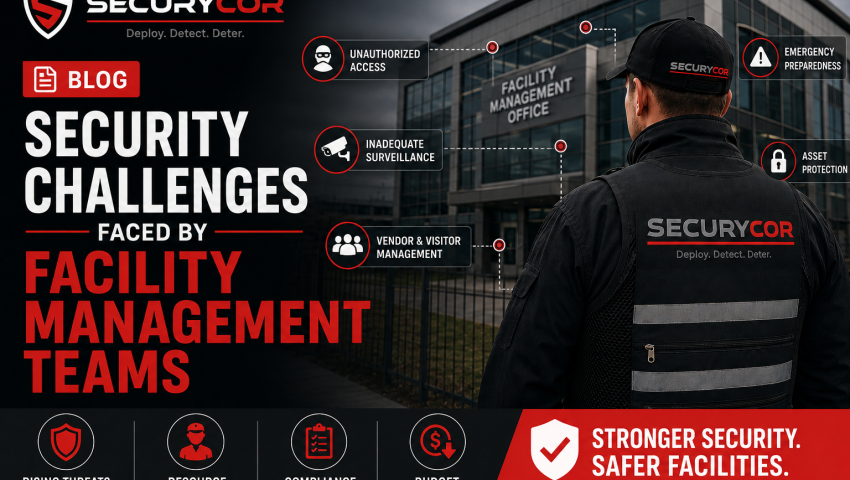
Security Challenges Faced by Facility Management Teams in 2026
 By Securycor LTD
- Jun 08, 2026
- 8 minutes read
- 257 Views
Discover the security challenges faced by facility management teams and learn how professional security services reduce risk and improve compliance.
Facility management has evolved far beyond building maintenance and contractor coordination. In 2026, facilities managers are responsible for protecting people, assets, operations, compliance standards, and business continuity across increasingly complex environments.
From commercial offices and industrial facilities to logistics hubs, warehouses, retail sites, and public buildings, organisations across the United Kingdom face growing security risks that require proactive planning and professional oversight.
The security challenges faced by facility management teams continue to increase due to changing workplace practices, rising operational demands, stricter compliance expectations, and more sophisticated security threats.
Security is no longer a reactive function. It has become a strategic component of facilities management that directly impacts safety, reputation, compliance, and organisational resilience.
This guide explores the key security challenges facing facilities management teams in 2026 and explains how professional security services can help organisations reduce risk, maintain compliance, and support uninterrupted operations.
Direct Answer
Security is a critical priority for facilities management because it protects people, property, operations, compliance obligations, and business continuity while reducing operational and reputational risk.
Why Security Is Becoming a Critical Priority for Facilities Management
Modern facilities management now extends far beyond maintenance and operational oversight. Facilities teams are increasingly expected to manage complex security responsibilities that directly affect organisational performance and resilience.
Security incidents can cause significant disruption, financial loss, reputational damage, and legal consequences. As a result, security planning has become a fundamental part of facilities management strategies across both public and private sectors.
Key Security Responsibilities Include:
- Protecting employees, visitors, and contractors
- Preventing unauthorised access
- Securing buildings and critical infrastructure
- Safeguarding equipment and valuable assets
- Supporting health and safety compliance
- Maintaining business continuity
- Meeting insurance and regulatory requirements
- Responding effectively to emergencies and incidents
As threats continue to evolve, facilities managers must adopt a proactive security approach that combines people, technology, policies, and professional security services.
Challenge 1: Unauthorised Access and Trespassing
One of the most common security challenges faced by facility management teams is controlling access to buildings and restricted areas. Unauthorised individuals can pose serious risks to employees, assets, confidential information, and operational continuity.
As facilities become larger and more complex, maintaining secure access across multiple entry points becomes increasingly difficult. Commercial buildings, industrial sites, warehouses, and public facilities all face ongoing challenges related to access management.
Common Causes of Unauthorised Access
- Weak perimeter security
- Poor access control procedures
- Tailgating through secure entrances
- Unsecured gates and doors
- Lack of out-of-hours monitoring
Unauthorised access can lead to theft, vandalism, data breaches, health and safety incidents, and significant operational disruption. In some cases, a single security breach can result in substantial financial and reputational damage.
Facilities managers increasingly rely on professional security officers, monitored access control systems, visitor management procedures, and mobile patrol services to reduce these risks and maintain secure environments.
Security Insight: Effective access control is often the first line of defence against wider security incidents. Preventing unauthorised entry significantly reduces the likelihood of theft, vandalism, and safety breaches.
Challenge 2: Theft, Vandalism and Criminal Damage
Theft, vandalism, and criminal damage remain major concerns for facilities management teams across the UK. Commercial premises, industrial sites, warehouses, retail locations, and construction projects are frequent targets due to the presence of valuable assets and equipment.
Criminal activity can occur during business hours, overnight, or during periods of reduced occupancy. Without effective security measures, facilities may experience significant financial losses and operational disruption.
Common Targets for Theft
- IT equipment and technology assets
- Machinery and specialist equipment
- Tools and maintenance equipment
- Vehicles and fleet assets
- Inventory and stock
- Sensitive business information
Vandalism can be equally damaging. Graffiti, broken windows, damaged infrastructure, and deliberate destruction often result in costly repairs and can negatively impact the organisation's reputation.
Potential Consequences
- Costly repairs and replacement expenses
- Increased insurance claims and premiums
- Project and operational delays
- Damage to business reputation
- Additional security expenditure
Facilities managers increasingly implement layered security strategies that combine manned guarding, CCTV monitoring, access control systems, alarm response services, and mobile patrols to deter criminal activity and protect valuable assets.
Professional Security Reduces Operational Risk
Visible security officers, monitored CCTV systems, mobile patrols, and rapid response procedures provide a powerful deterrent against theft, vandalism, and criminal damage while supporting business continuity.
Challenge 3: Health & Safety Security Risks
Health and safety responsibilities are closely linked to security management. Facilities teams must ensure that buildings remain safe, secure, and compliant while protecting employees, contractors, visitors, and members of the public.
Security failures can quickly become health and safety incidents, resulting in injuries, legal liabilities, compliance breaches, and reputational damage.
Common Health & Safety Security Concerns
- Unauthorised individuals entering restricted areas
- Unsafe access to plant rooms and machinery
- Emergency evacuation failures
- Poor visitor management procedures
- Insufficient monitoring of high-risk areas
- Failure to comply with safety regulations
Professional security services help facilities managers maintain safer environments by supporting access control, incident response, emergency procedures, and compliance monitoring.
Compliance Focus: Strong security procedures directly support health and safety obligations while reducing operational and legal risks.
Challenge 4: Cyber & Physical Security Integration
As buildings become smarter and more connected, facilities management teams must address both physical and digital security threats. Modern access control systems, CCTV networks, alarm systems, and building management platforms all rely on technology infrastructure.
This convergence means that cyber vulnerabilities can directly impact physical security operations and vice versa.
Emerging Security Risks in 2026
- Compromised access control systems
- Network-connected CCTV vulnerabilities
- Building management system attacks
- Data breaches affecting security operations
- Remote access exploitation
Facilities managers must increasingly collaborate with IT teams, cybersecurity specialists, and security providers to ensure integrated protection strategies are in place.
Integrated Security Delivers Better Protection
Combining physical security measures with cybersecurity best practices helps organisations reduce vulnerabilities, improve resilience, and maintain operational continuity.
Challenge 5: Staffing & Resource Constraints
Many facilities management teams face increasing pressure to maintain security standards while operating with limited budgets, reduced staffing levels, and growing operational responsibilities.
As organisations seek greater efficiency, facilities managers are often expected to manage multiple sites, contractors, compliance obligations, and security requirements simultaneously.
Common Resource Challenges
- Limited internal security personnel
- Budget restrictions
- Increasing compliance responsibilities
- Managing multiple facilities simultaneously
- Out-of-hours monitoring requirements
- Recruitment and retention difficulties
Professional security providers help facilities managers overcome these limitations by providing trained personnel, specialist expertise, technology solutions, and scalable security services tailored to operational requirements.
Operational Advantage: Outsourcing security functions allows facilities teams to focus on strategic responsibilities while maintaining high levels of protection and compliance.
Challenge 6: Emergency Response & Business Continuity
Unexpected incidents can significantly disrupt business operations. Facilities management teams must be prepared to respond quickly and effectively to emergencies while maintaining the safety of people, assets, and critical infrastructure.
Business continuity planning has become a major focus for organisations seeking to minimise operational downtime and maintain resilience in an increasingly unpredictable environment.
Potential Emergency Scenarios
- Fire incidents
- Security breaches
- Medical emergencies
- Critical infrastructure failures
- Severe weather events
- Major operational disruptions
Without effective emergency planning and response procedures, organisations risk prolonged downtime, financial losses, reputational damage, and increased liability.
Prepared Organisations Recover Faster
Effective emergency response planning, trained personnel, and professional security support help organisations minimise disruption and maintain business continuity during critical incidents.
Why Businesses Choose Securycor
Organisations across Milton Keynes and throughout the UK trust Securycor because of its professional, compliance-focused approach to security and facilities support services.
Why Securycor?
- Fully trained professional security personnel
- Rapid deployment capabilities
- 24/7 monitoring and response support
- Compliance-focused security solutions
- Tailored protection strategies
- Nationwide support capability
Frequently Asked Questions
What are the biggest security challenges facing facility management teams in 2026?
The most significant challenges include unauthorised access, theft, vandalism, health and safety risks, cyber-physical security integration, staffing constraints, and emergency response preparedness.
Why is security important in facilities management?
Security protects people, assets, infrastructure, and operations while helping organisations maintain compliance, reduce risk, and support business continuity.
How can facilities managers improve site security?
Facilities managers can improve security through access control systems, CCTV monitoring, professional security personnel, mobile patrols, incident response procedures, and regular risk assessments.
What role does technology play in modern facilities security?
Technology supports surveillance, monitoring, access control, reporting, incident management, and integration between physical and cybersecurity systems.
Why do businesses outsource security services?
Outsourcing provides access to specialist expertise, trained personnel, advanced technology, and scalable security solutions without the costs associated with maintaining large in-house security teams.
Conclusion
Security challenges facing facility management teams continue to evolve as organisations become more complex, connected, and operationally demanding. Facilities managers are now expected to manage a wide range of risks that directly affect people, assets, compliance, and business continuity.
Addressing these challenges requires a proactive approach that combines professional security services, effective policies, modern technology, and ongoing risk management strategies.
By investing in appropriate security measures, organisations can reduce vulnerabilities, strengthen resilience, and create safer environments for employees, visitors, and stakeholders.
Deploy. Detect. Deter.
Partner with Securycor for professional security solutions designed to protect facilities, people, assets, and business operations across Milton Keynes and throughout the United Kingdom.