

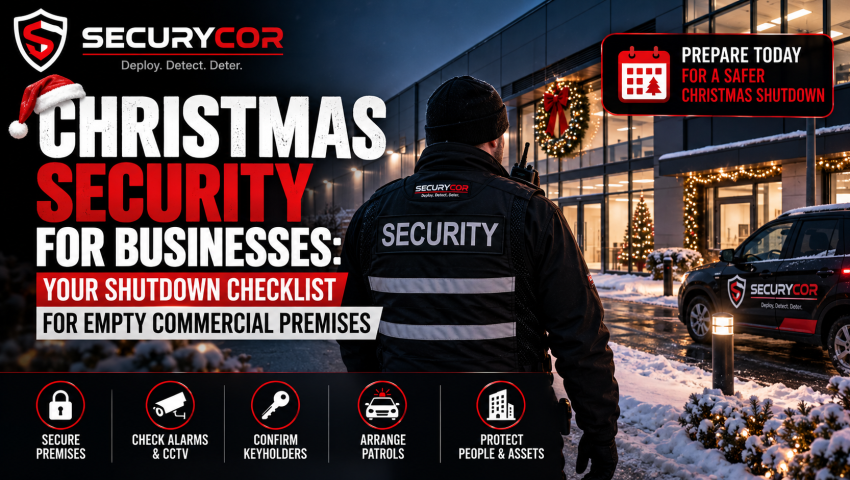

At 5.40pm on 23 December, the last person out checks the kitchen, switches off the lights and pulls the door shut. Nobody will be back for eleven days. The alarm's set, probably. The keyholder list dates from last year, and one name on it has since left. That's the gap Christmas security for businesses has to close.
How do you secure an empty business over Christmas? Walk the premises before closing, test your alarm and CCTV, confirm who holds keys and who answers calls, and arrange visits during the closure. Patrols, monitored CCTV or a guard fit different risks, and the contact plan matters as much as any hardware. Book cover in November.
Why are empty buildings more exposed over the holidays?
Empty buildings are more exposed because nothing interrupts a problem. On a normal weekend, someone calls in to collect a file, a neighbouring unit has staff on a Saturday, or a cleaner arrives on Monday. Over Christmas those routines stop, and the gap between anyone looking at the building stretches from hours to days.
Fewer people nearby makes it worse. Industrial estates go quiet and office blocks empty out. A van parked at a loading bay for an hour doesn't look odd when there's nobody around to find it odd.
The costly part is delayed discovery. A forced rear door on 27 December that's found on 4 January has had a week to get worse, and the same goes for a failed alarm panel or a door that never latched. Good empty building security isn't only about deterring a burglar. It's about shortening the time between something going wrong and somebody knowing.
Christmas security for businesses: your pre-closure walk-round checklist
Do this on your last working day, in daylight if you can, with a printed copy and a pen.
- External doors and windows: Try every one by hand rather than looking at it. Pay attention to ground-floor windows nobody opens and fire doors that look shut but haven't latched.
- Roof and fire-escape access: Check hatches, ladders and external stairs. Look for anything that gives a route up, including a fire escape door that won't pull fully shut.
- Bins and skips: Move them off walls and away from windows. A skip left against a rear wall is a free step onto a flat roof, and it's usually been there since October.
- Valuables and laptops: Lock them in a safe or secured room, not a desk drawer. Clear desks so nothing attractive shows through the glass.
- Heating and water: Leave heating on a low frost setting rather than switching it off, and agree with your building manager what should be isolated. A pipe that freezes on 27 December can flood a floor before anyone's through the door.
- Lighting: Decide what stays on, then check external lights and timers after dark, not at lunchtime.
- Signage: Make sure signs match reality. A notice claiming patrols or monitoring you haven't arranged does you no favours.
Check your systems before you lock up
Do this a day or two before closing, so there's time to fix what fails. It's the part of Christmas shutdown security people skip, because the building looks fine.
- Alarm test: Run a full set and unset, covering every zone rather than just the front door. Tell your alarm company your closure dates.
- CCTV recording and remote access: Check that cameras are recording, storage isn't full and the clock is right. Then log in from off site. A camera you can't reach is just a recorder.
- Monitoring contact details: Send the monitoring centre your current call list and say it's for the holiday period.
- Keyholder list: Remove leavers and confirm each keyholder's availability dates.
- Spare keys: Find out who holds them: contractors, cleaners, a former tenant. Account for every set and change codes where someone's left.
Patrols, monitored CCTV or a guard on site?
Each option does a different job.
| Option | Best for | Limitations |
|---|---|---|
| Mobile patrols | Offices, schools and light industrial units where scheduled visits to check doors, lights and the building's condition are enough | Visits are periodic, so an incident can start and finish between them |
| Monitored CCTV | Large yards, loading areas and premises with valuable stock where you want eyes on the site between visits | Needs a defined response behind it; cameras alone don't stop anyone |
| Guard on site | Higher-risk premises, high-value stock, or anywhere an incident would be costly or dangerous | Highest cost, and one guard can only be in one place at a time |
Most premises land in the middle. A typical pattern is monitored CCTV to spot trouble, holiday security patrols to check the building and respond, and a guard for the highest-risk days or assets. Business closure security works best when all the pieces share one contact plan. You can read more in our guide to monitored CCTV, or look at our mobile patrol and static security services.
Who gets called, and in what order?
Agree this before closing and pin it by the door and in the office. If people are at risk or a crime's in progress, skip the list and call 999.
- First responder. The patrol or monitoring contact verifies what's happened and reports back.
- Keyholder. Attends if someone needs to get in to secure the building. A key holding service removes the dependence on a member of staff's availability.
- Site or FM manager. Decides on repairs, boarding up and contractors, and approves spend.
- Emergency services. Police, fire or ambulance as the situation demands, with the address and the exact entrance.
- Insurer or broker. Report as soon as practical and check your policy for notification terms.
Now the awkward bit. People on leave don't answer. Name a deputy for every role and tell each deputy they're on the list. A keyholder who's on a flight to visit family on Boxing Day is no use to anyone at 3am, however reliable they are the rest of the year. For what happens after an alarm activates, see our alarm response service.
When should you book holiday security cover?
Book in November. Patrol routes and guard rosters tend to fill as December goes on, and a provider who's surveyed your site, agreed the contact plan and received your keys by mid-November is in a different position from one handed it all on 19 December. Our operations team can mobilise in an emergency within 48 hours, but that's a fallback for when something's gone wrong, not a planning strategy.
When you speak to any provider, ask:
- Licensing: Are the officers SIA-licensed, and can they show you?
- Keys: Where are they stored, how are they released, and to whom?
- Reporting: Do you get time-stamped reports for each visit?
- Holiday availability: Who's working on 25 and 26 December, and is the control room staffed?
- Incidents: What happens when an officer finds a door open at 3am on Boxing Day?
Accreditations are worth asking about too. SECURYCOR holds ISO 9001, Constructionline Gold, CHAS, SafeContractor and COP119, and you should expect any provider to show you their certificates. Ours is a 24/7 operation, so the control room doesn't close for the bank holiday.
Book Christmas Security Cover for Your Premises
Frequently asked questions
How do I secure my business over Christmas?
Check the building and its systems before you close, then decide who'll look at the premises while you're away. Write down who to call, with a deputy for each person, so nobody's guessing on the day.
Is an alarm alone enough to protect an empty building?
Usually not. An alarm tells someone something has happened, but it doesn't mean anyone attends, and a real activation looks like a false one until somebody checks. Pair it with an arrangement that sends a person to look.
Should I choose security patrols or a guard for the holidays?
Patrols suit premises where regular checks are enough, and a guard suits places where continuous presence is justified, such as high-value stock. The deciding questions are what an incident would cost and how long you can leave the building between visits.
How far ahead should I book Christmas security cover?
Ideally in November, and certainly before the first week of December. That gives time for a site survey, an agreed contact plan and a key handover. Last-minute cover is sometimes possible, but it depends on availability.
What should I tell my insurer about a Christmas closure?
Check your policy for conditions on unoccupied premises, such as inspection frequency, and tell your insurer or broker about a planned closure. Keep dated records of your checks and any visits, because they're useful if you ever need to make a claim.
Key takeaways
- Give the closure one named owner. Most gaps come from everyone assuming someone else locked up or tested the system.
- Test, don't assume. A system you've watched working is worth more than one you believe is working.
- Match cover to what's inside the building. The right mix for a stocked warehouse isn't the right mix for a school office.
- Keep dated notes of the walk-round, the tests and any visits. They help with the handover on your return and any conversation with your insurer.
- Plan the return as well. Have one person walk the building on 4 January before staff arrive, so a problem is found by one person rather than a whole team.
For site-specific advice on construction sites during the winter months, Contact Securycor for consultation.