

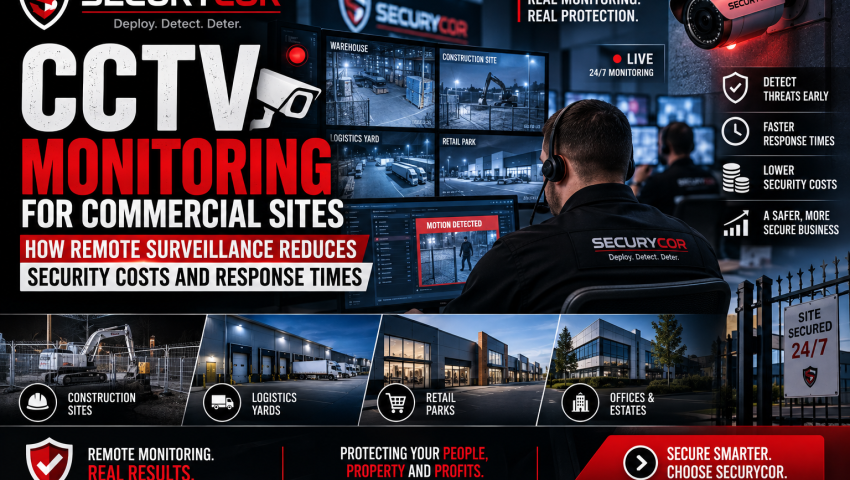
CCTV Monitoring for Commercial Sites: How Remote Surveillance Reduces Security Costs and Response Times
 By Securycor LTD
- Industrial Security
- Sep 15, 2026
- 6 minutes read
- 15 Views
Most commercial sites can't justify the cost of 24-hour static guarding. Remote CCTV monitoring offers an alternative: live video monitoring with a documented, auditable response process, at a fraction of the cost.
What Is Remote CCTV Monitoring?
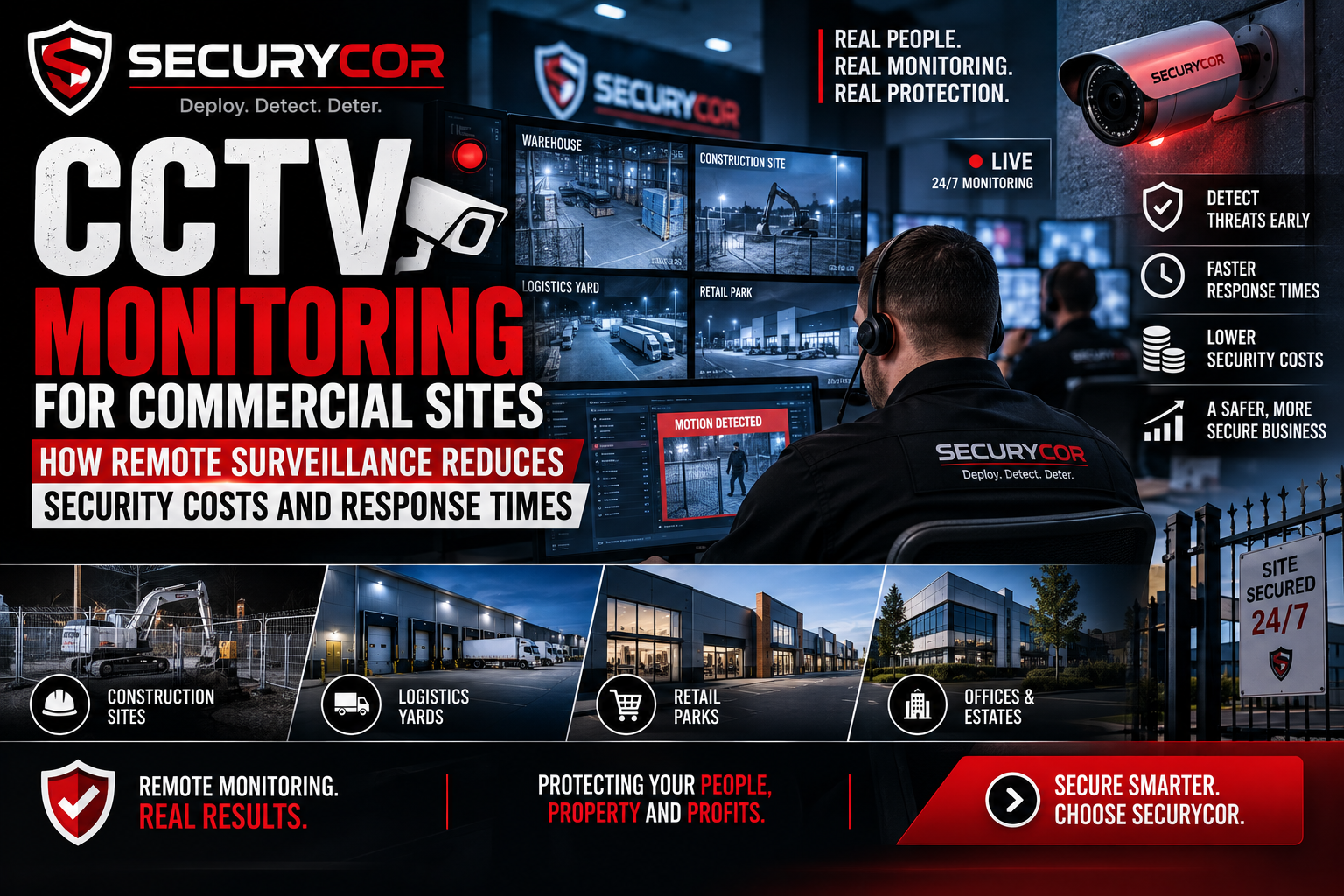
Remote CCTV monitoring connects site cameras to an off-site monitoring centre. Trained operators watch live or event-triggered footage in real time. When the system detects unauthorised activity, operators verify it first. They then follow an agreed escalation procedure an audio warning, a keyholder call, or a request for police or mobile patrol attendance. Every action is logged for audit. This is what makes monitored CCTV useful for businesses that need more than a camera feed.
How Does Remote CCTV Monitoring Work?
The process runs in five steps.
01 Detection
Cameras with motion or perimeter-intrusion analytics flag activity against a pre-set alert rule.
02 Transmission
The alert and video are sent securely to the monitoring centre.
03 Verification
An operator checks the footage to confirm it's a genuine incident, not a false alarm.
04 Escalation
The operator follows the agreed protocol: an audio challenge, a keyholder call, a mobile patrol dispatch, or a police contact.
05 Reporting
Every action taken is logged and ready for audit-ready reporting to FM and compliance teams.
Unmonitored CCTV is a forensic record. It tells you what happened after the fact. Monitored CCTV is an active control. It catches what is happening and triggers a response in real time.
CCTV Monitoring vs Manned Guarding
| Factor | Remote CCTV Monitoring | Static Manned Guarding |
|---|---|---|
| Coverage | Multiple zones from one centre | Guard(s) physically on site |
| Cost driver | Installation plus monitoring contract | Hourly rates by headcount/shift |
| Incident response | Verification, then remote escalation | Immediate physical intervention |
| Multi-site scaling | Centralised one centre, many sites | Linear more sites need more staff |
| Audit trail | Time-stamped video and operator logs | Manual guard logbooks |
| Best suited to | Perimeters, unoccupied/out-of-hours sites | Access control, visible presence, hands-on need |
SECURYCOR clients typically use monitoring alongside scheduled mobile patrols or alarm response, rather than choosing one over the other.
Why Does CCTV Monitoring Save Money?
01 Pricing
Pricing is based on cameras and sites, not guarding hours. This avoids the cost growth of round-the-clock static guarding.
02 Centralised Monitoring
One monitoring centre spreads its fixed costs across a client's full portfolio.
03 Confirmed Incidents
Operators verify every alert before escalating. Callouts are usually reserved for confirmed incidents.
What Response Times Should Commercial Sites Expect?
Response runs across three phases.
| Phase | What It Covers | What Drives the Time |
|---|---|---|
| Alert-to-verification | Trigger to operator confirmation on the live feed | Operator response speed and alert accuracy |
| Verification-to-escalation | Confirmed incident to first response action | The client's agreed escalation protocol |
| Dispatch-to-arrival | Dispatch to physical arrival on site | Patrol proximity or police call prioritisation |
How Does CCTV Monitoring Work on Construction Sites?
Construction sites are SECURYCOR's core market for remote monitoring, and the challenges are specific.
Changing boundaries. As a build progresses, the site perimeter shifts. SECURYCOR repositions cameras and updates coverage plans at each phase, rather than fixing camera positions for the life of the project.
Rapid deployment towers. These are self-contained, solar-powered camera towers. They need no fixed power or permanent groundworks, which suits a site that keeps changing shape.
Aligned to the phase plan. Camera positions and coverage plans are reviewed against the construction phase plan and site RAMS. Monitoring tracks the site instead of lagging behind it.
A typical out-of-hours incident. A camera detects movement on an unoccupied site late at night. An operator verifies it's a person, not wildlife or weather. The operator issues an audio warning. If the person doesn't leave, the operator contacts the client's nominated keyholder and requests a mobile patrol or police attendance. Detection, verification, escalation and outcome are all logged and available the next morning.
Blended with manned guarding. During occupied working hours, monitoring runs alongside manned access control rather than replacing it. Guarding covers the site while people are on it. Monitoring covers the site once they've gone home.
What Should a Buyer Look for in a CCTV Monitoring Provider?
Not all monitoring providers operate to the same standard. Before committing to a contract, buyers should verify five things.
Operator licensing. Every operator viewing live footage and making escalation decisions should be SIA licensed. Ask for evidence, not just a claim on a website.
Quality management. ISO 9001 certification confirms the provider operates within a documented, auditable quality management system. This matters when your compliance team or end-client asks for evidence of supplier governance.
Supply chain accreditation. Constructionline Gold, CHAS and SafeContractor confirm the provider meets pre-qualification standards recognised across construction and FM procurement. If you need to justify a supplier choice to a principal contractor or end-client, these are the accreditations they'll look for.
Data handling and cyber security. CCTV captures personal data under UK GDPR. The provider should demonstrate a lawful basis for processing, documented retention policies, clear subject access request procedures, and Cyber Essentials certification as a minimum for cyber hygiene.
Audit-ready reporting. Every alert, verification, escalation and outcome should be time-stamped and available on demand. If a provider can't produce a clean incident log within 24 hours of a request, their reporting isn't audit-ready.
SECURYCOR holds ISO 9001, Constructionline Gold, CHAS, SafeContractor and COP119, and delivers monitoring services with time-stamped, audit-ready reporting as standard.
For sites combining CCTV with access control or manned response, SECURYCOR's integrated security services bring these under one governance framework.
Frequently Asked Questions
It's priced per camera or site, not by guard hours.
Response runs through verification, escalation and, where needed, dispatch. See "What Response Times Should Commercial Sites Expect?" above for how each phase is timed.
Often not for unoccupied sites, perimeters, and out-of-hours cover, where a guard's role would mainly be observation. Sites that need access control or hands-on intervention typically still need guarding, usually paired with monitoring rather than instead of it.
Yes, provided the provider has documented policies. Under UK GDPR, CCTV footage of identifiable people counts as personal data, so a compliant provider needs a lawful basis for processing, a retention policy, and a clear subject access request process. Ask any provider to confirm their approach and Cyber Essentials status.
Look for SIA licensing on monitoring and response staff, ISO 9001 certification, Constructionline/CHAS/SafeContractor status, and Cyber Essentials. These confirm the provider meets the governance standards most FM and construction procurement teams require.
Key Takeaways
- Remote CCTV monitoring connects on-site cameras to an off-site centre, where operators verify alerts and escalate confirmed incidents through an agreed protocol.
- Monitored CCTV is an active control that triggers a real-time response. Unmonitored CCTV only records what happened after the fact.
- Pricing is based on cameras and sites, not guarding hours, and one monitoring centre can cover a client's full portfolio.
- Response runs through three timed phases alert-to-verification, verification-to-escalation, dispatch-to-arrival and a provider should be able to state SLA times for each.
- On construction sites, SECURYCOR repositions cameras as boundaries shift and pairs remote monitoring with manned guarding during occupied hours.
- Buyers should check SIA licensing, ISO 9001, Constructionline/CHAS-SafeContractor, Cyber Essentials, GDPR compliance and audit-ready reporting before choosing a provider.
Talk to SECURYCOR about CCTV monitoring for your site.