

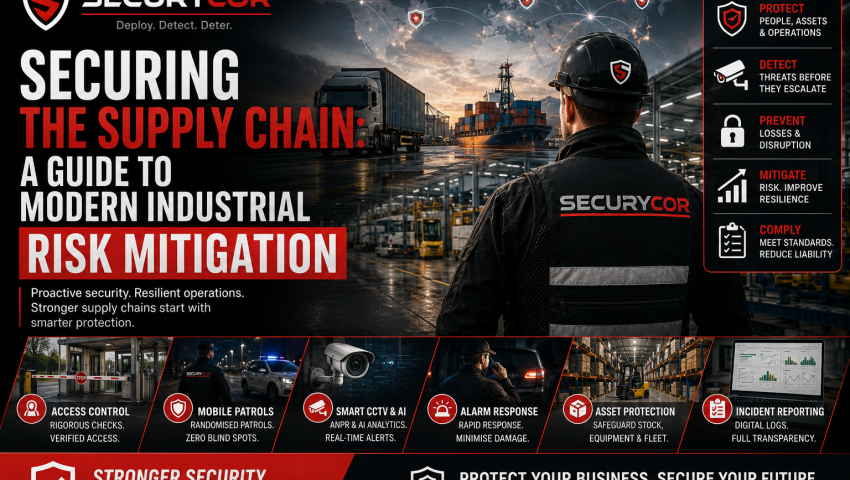
Securing the Supply Chain: A Guide to Modern Industrial Risk Mitigation
 By Securycor LTD
- Jul 12, 2026
- 6 minutes read
- 225 Views
Industrial facilities are the operational backbone of the UK economy. Warehouses, manufacturing plants, logistics hubs, and distribution centres handle massive concentrations of high-value stock, raw materials, complex machinery, and fleet vehicles. Consequently, they have become primary targets for sophisticated criminal networks specialising in cargo theft, organised disruption, and asset stripping.
As physical and digital threats evolve, legacy security measures such as basic mechanical locks or unmonitored local alarms are no longer sufficient. Protecting expansive commercial footprints requires a proactive, layered security architecture. For facility managers and operations directors, understanding how risk profiles are changing is the first step toward guaranteeing long-term business continuity.
"According to the National Vehicle Crime Intelligence Service (NaVCIS) annual data, UK HGV and cargo crime reached 3,424 recorded incidents across 2025, nine thefts a day, with an estimated £65.1 million in direct cost-price losses. NaVCIS's own field intelligence officers caution that once policing, insurance, and reputational costs are factored in, the true economic impact is likely three to four times higher."
The Core Components of Industrial Asset Protection
Unlike standard retail or corporate office security, industrial asset protection operates on a massive physical scale. It requires managing constant multi-vehicle transit, heavy machinery operations, and expansive perimeters.
An effective, modern industrial security services framework relies on an integrated ecosystem of physical personnel and intelligent technical systems working in tandem:
- Access Control & Perimeter Gatehouse Management: Enforcing rigorous digital tracking and manual verification of staff, contractors, and transport drivers at all entry points.
- Randomised Mobile Patrols: Executing unpredictable structural integrity and perimeter checks to eliminate blind spots and deter opportunistic trespassers.
- AI-Driven Video Analytics: Upgrading traditional CCTV to smart networks utilising Automatic Number Plate Recognition (ANPR) and behavioural AI to flag unauthorised vehicles or unusual perimeter loitering before a breach occurs.
- Key Holding & Rapid Alarm Response: Deploying dedicated, off-hours incident response protocols to mitigate damage without putting internal staff at risk.
- Digital Incident Reporting: Maintaining transparent, compliance-ready logs of site vulnerabilities, maintenance issues, and safety hazards in real time.
High-Risk Profiles: Warehouses & Logistics Hubs
Warehouses and distribution centres serve as central consolidation points for valuable inventories awaiting distribution. This high concentration of liquid assets makes them incredibly attractive to organised criminal syndicates whose tactics have evolved far beyond simple opportunistic break-ins.
The Rise of Deceptive Pickups
Force has increasingly been overtaken by fraud as a primary driver of UK cargo theft. Organised networks now utilise "deceptive" or "fictitious" pickups exploiting digital freight platforms, using spoofed corporate domains, and presenting cloned delivery credentials at gatehouses to simply drive away with entire trailers of electronics or pharmaceuticals. This shift makes rigorous physical gatehouse verification a critical operational necessity.
Fleet and Fuel Vulnerabilities
With bulk diesel prices heavily impacted by global volatility, industrial sites have faced a massive surge in large-scale fuel theft. Criminal syndicates now utilise modified commercial vans equipped with concealed intermediate bulk containers (IBCs) and motorised pumps, enabling them to siphon tens of thousands of litres of white diesel directly from parked HGVs and static storage tanks in a single overnight operation.
Supply Chain Cascading Failures
If a major distribution centre is paralysed by vandalism, arson, or a major asset breach, the resulting operational downtime ripples across the entire supply chain. The financial fallout often includes severe contractual penalties for missed Service Level Agreements (SLAs), skyrocketing insurance premiums, and permanently eroded client trust.
Operational Pressures: Manufacturing & Production Plants
Manufacturing and production facilities operate under entirely different pressures. Here, a security breach does not just result in stolen inventory it directly disrupts production lines, triggers health and safety liabilities, and threatens regulatory compliance.
- High-Value Commodities and Plant Machinery: Factories house expensive precision tooling, specialised plant equipment, and raw commodities like copper and micro-components. These assets have highly lucrative, established illicit resale markets and are difficult to replace quickly due to specialised supply chain lead times.
- Complex Contractor and Workforce Management: With hundreds of shift workers, specialised field engineers, and delivery drivers entering and exiting daily, maintaining an accurate on-site log is exceptionally difficult. Weak gatehouse control directly exposes sensitive production zones to unauthorised personnel.
- Health, Safety, and Legal Liabilities: Unauthorised trespassers entering a heavy industrial environment face severe injury risks from automated machinery and hazardous materials. A perimeter breach that results in an injury exposes the business to severe Health and Safety Executive (HSE) investigations, legal liabilities, and regulatory fines.
The Business Case for Integrated Security Architecture
In corporate budgeting, security is occasionally mischaracterised as a static operational expense. However, evaluating security through a risk-management lens reveals it to be a critical investment in profitability protection.
A proactive, multi-layered security strategy directly defends against the compounding costs of unplanned production line downtime, asset replacement lead times, and environmental remediation costs following vandalism.
Ultimately, robust physical security serves as a distinct commercial advantage. Major retail partners and multinational corporations are far more likely to award lucrative, long-term contracts to logistics and manufacturing hubs that can definitively prove their operations are resilient, compliant, and secure.
Evaluating Professional Security Standards
When auditing internal frameworks or vetting external security partners, adherence to recognised industry benchmarks is critical. In the UK, credible industrial security operations should align with strict quality management and health and safety standards, including:
- SIA Licensing: Ensuring all deployed personnel are fully vetted and trained specifically for high-risk commercial environments.
- ISO 9001:2015: Adherence to internationally recognised UKAS-certified quality management systems and continuous operational improvement.
- COP 119: Conformance to recognised industry codes of practice for professional guarding and operational deployment.
- Health & Safety Accreditations: Verification through bodies such as CHAS, SafeContractor, or SSIP, ensuring security operations do not compromise facility safety protocols.
By treating industrial security as a dynamic, integrated system rather than a series of isolated measures, facilities can successfully protect their personnel, secure their supply chains, and insulate their bottom lines from external disruption.
Frequently Asked Questions
How much do industrial security services cost?
The cost depends entirely on your site's physical scale, required officer deployment hours, and technology integrations (such as AI-driven CCTV or ANPR). Securycor offers bespoke, flat-rate pricing models based on a comprehensive operational risk assessment.
Can integrated security services reduce corporate insurance premiums?
Yes. Many commercial insurers mandate strict physical security frameworks for high-risk spaces. Deploying directly employed, SIA-licensed gatehouse control and structured mobile patrols can directly mitigate risks, lowering insurance claims, liability exposure, and policy renewal premiums.
Are Securycor officers subcontracted or directly employed?
We operate a strict direct employment policy. We do not use third-party sub-contractors, which ensures maximum accountability, consistent compliance reporting, and rigid control over our training standards.
Secure Your Operational Continuity
Securycor delivers bespoke security frameworks engineered for high-risk UK commercial environments. Rather than utilising subcontracted templates, our directly employed officers provide verified, compliance-focused protection designed around your exact facility risks.